- A photograph
I was leafing through an old National Geographic compilation book called As We Live and Breathe, The Challenge of Our Environment, when I chanced upon a two-page spread devoted to the Huckleby family and a large photograph that took my breath away. I reproduce it here, not knowing who the photographer or copyright holder is. {UPDATE: James P. Blair is the photographer – he commented on this entry. Thank you, James!}
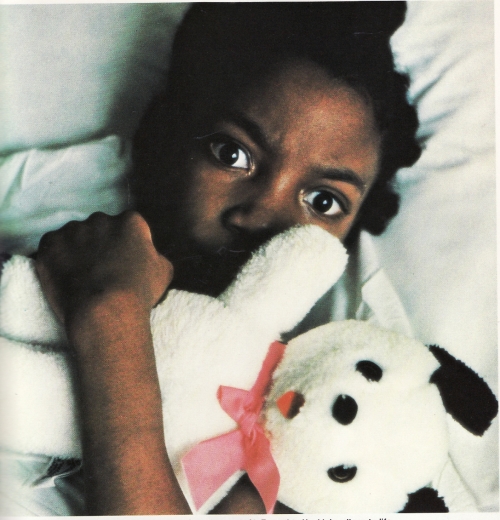
This is Ernestine Huckleby.
- Ernestine’s story
In 1969, in Alamogordo, New Mexico, her family sat down to a meal of pork from a hog they had raised themselves. A year earlier, the pig had been fed grains that were not meant for consumption (animal or human), but only for planting more grains. They had been treated with the pesticide Panogen, which contained methyl mercury.
Though all the family members showed high doses of mercury in their bodies, only three of the childen were severely affected. There is conflicting information on the web. The most repeated story is that “one was deafened, another was blinded, a third arrived at the hospital raving mad.” The photographs in the National Geographic book paint a more complex picture: a young woman (Dorothy Jean Huckleby) learning to walk with crutches, and a teenager (Amos Charles), blind but learning to speak again. Of the little girl, whose age I can’t ascertain, the book says “Blinded, mute, her hearing and powers of movement severely impaired, Ernestine Huckleby clings to life”.  There also seems to have been a baby still in utero when her mother ate the pork, and she was born with a severely damaged central nervous system.
- Iconized and forgotten
Back in 1970, when the story made national headlines, it forced the U.S. Department of Agriculture (USDA) to ban and recall all mercury-containing pesticides.  Today “the Huckleby Poisoning” still stands as one of the icons for the innocents who are harmed by environmental destruction in the interest of commercial gain and under the “watchful” eye of the government.
But Ernestine, she is forgotten.
When you Google “Ernestine Huckleby”, you get one irrelevant search result. The web, where everyone lives nowadays, does not acknowledge her.
This iconization is a good thing: such images stick in our minds and move our hearts like no theory, accumulation of scientific data or political manifesto can. They make us think, feel, speak out. But does it have to come at such a price?
- Dreaming of Ernestine
The world snapped a picture. The face became an icon. It discarded the little girl behind it, behind those eyes.
Tonight I will dream of Ernestine, dancing and skipping, singing and laughing. Then I will dream about the world slamming shut on her. Is she still there, in that little girl clutching the stuffed animal with the pink bow? It is terrible to admit it: I hope not. I hope Ernestine too forgot herself. The alternative is simply too horrific.
Update: more of Ernestine’s story here.


Maybe she recovered? I don’t know. But that too is something to hope for? But you’re right, we should be reminded of these stories as well as of the real people behind them. Let us know if you find something!
I first read this case in law school this year. Know that in 2007, this case is still alive and well in the Products Liability context under the deterrence rationale.
The case sums it up like this:
“Allowing injured plaintiffs to proceed on a theory of a manufacturer’s liability, without the necessity of proving negligence, will cause manufacturers to take cautionary steps to prevent the marketing of dangerously defective products.”
Thanks, William, for the information. It is good to know that Ernestine still functions as an icon – a deterrent, as you say. Do you happen to know what happened to *her*, though? Is there any information about that in the law books?
Ernestine died at age 29. She never recovered, was blind, demented and mute according to a follow-up paper written 22 years after the incident. Unfortunately, organic mercury damage is usually largely permanent. Paper is L. Davis et al, Annals of Neurology 1994 vol 35, no.6 p680-688. The Hucklebys have not been totally forgotten in the public health world!
Thank you all for remembering my family. As everyone knows Ernestine (my aunt)passed away and so did Michael who my grandmother was pregnant with at the time. My aunt Dorothy is married to wonderful man and still resides in Alamogordo. My uncle Amos is still at home under the care of my grandmother full time. He is still blind and left with the all the physical damage of mercury poisoning. It gives my daughter and I great love to know that there are still people out there concerned for my family and i thank everyone for the kind words.
I knew your family when we live on Brookdale Street in Alamogordo. I am so sorry for your family’s loss. I met Ernestine and Amos and went to school with Teresa. One of my favorite memories of Amos is him sitting in the front room listening to a football game and enjoying it. I had heard that Amos was going to attend the blind school in town and further his education. Did he? I hope so. Your family is in my thoughts and prayers. I will never forget them.
Dear Katrien,
I am the photographer who took the photograph of
Ernestine in 1970 that appears on page 77 of As We Live and Breath. I took most of the pictures for the book and my credit is at the top of page 76. Of all the assignments I have had over the 35 years I was a staff photographer for the Society this was one of the saddest. I am glad my picture touched you.
James P. Blair
As the Research Scientist at the Centers for Disease Control, Atlanta who identified the methyl mercury in Mr. Huclkeby’s farm animals, children and prregnant wife I have often wondered about their fate and recovery from this tragic incident. There were two prior cases of mercury poisonings in Japan and Guatamala. Based on my pharmacological knowledge of mercury I suspected that the damage woud be a lifetime affliction leading to a deadly end. My findings were published in Science, Vol 172, pp 65-67, 2 April 1972. If there are any family members still living, please write me at PO Box 143265, Fayetteville, GA 30215 or call 404-536-1488.
This is the abstract from a 1994 publication titled “Methylmercury poisoning: Long-term clinical, radiological, toxicological, and pathological studies of an affected family”, in the journal Annals of Neurology (volume 35, issue 6, pp. 680-688). The authors of the study include Dr. Larry E. Davis MD, Mario Kornfeld, Herbert S. Mooney MD, Kurt J. Fiedler MD, Kathleen Y. Haaland PhD, William W. Orrison MD, Elsa Cernichiari MS, and Thomas W. Clarkson PhD.
All of the terms for the conditions described below can be looked up through Google rather than have me enumerate them here:
For 3 months in 1969 a family in the United States that included a pregnant mother consumed pork containing methylmercury. Children, aged 20, 13, and 8 years and a neonate, developed severe neurological signs. Twenty-two years later, the 2 oldest had cortical blindness or constricted visual fields, diminished hand proprioception, choreoathetosis, and atentional deficits. Magnetic resonance images showed tissue loss in the calcarine and parietal cortices and cerebellar folia. The youngest had quadriplegia, blindness, and severe mental retradation until their deaths. The brain of the 8-year-old who died at age 30 showed cortical atrophy, neuronal loss, and gliosis, most pronounced in the paracentral and parietooccipital regions. The total mercury level in formalin-fixed, left occipital cortex was 1,974 ng/gm as measured by atomic absorption. Regional brain mercury levels correlated with extent of brain damage. A control patient had 38.5 ng of mercury/gm in the occipital cortex. Systemic organs in the patient and a control subject had comparable mercury levels. In mercury-intoxicated rats, we found that only 5 to 10% of total brain mercury was lost by formalin fixation. Brain inorganic mercury in the patient ranged from 82 to 100%. Since inorganic mercury crosses the blood-brain barrier poorly, biotransformation of methyl to inorganic mercury may have occurred after methylmercury crossed the blood-brain barrier, accounting for its persistence in brain and causing part of the brain damage.
There are plans in the works to dig up the site where both the grain and the hogs who consumed it are buried in Alamogordo on Saturday 4/26/14. The purpose of the dig is recovery of many copies of an Atari game based on the film ET. Digging at this site has been debated, but apparently it has received the OK from all environmental agencies.
I was in the Army with one of the children in Ft. Bliss. I read about this tragedy in Jet magazine
I was only about 10 when I saw the prologue of the tv show, I’ve never forgotten seeing poor Amos, a young black man blind, dark glasses, and in a wheelchair. All a result of a poisoned pig that was lovingly fed to the family. At 10 years old I couldn’t comprehend such sadness. Almost 50 years later, it’s still hard. God help him/them.