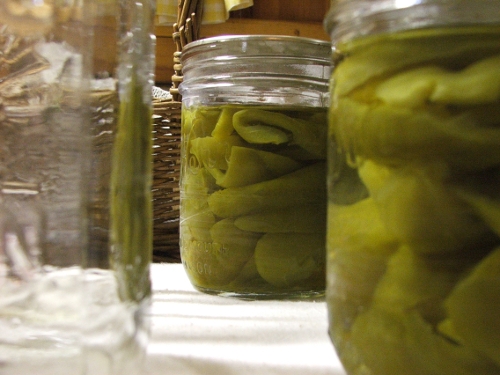
That’s the second person intimating to me that my home canning might not be safe. Usually the question comes quietly: “Are you sure the jars are okay?”
Though it riles me, I’ve come to expect the attitude. It’s like with eggs. When I tell people about wanting chickens for their eggs, half the time the reaction is: “But what about bird flu?”
The prevalent philosophy is that factory food must be safer: it’s more measured and controlled, and the processing is done by machines, and machines don’t make mistakes, and also, they preclude human contaminants.
That last one, I think, is what matters a lot to many people: they find the idea of human hands touching the food, or anyone breathing on it, icky. And the average home kitchen does not stack up against the scrubbed concrete tile and stainless steel scoopers and mashers and stirrers. The latter are self-cleaning, preferably.
And of course the food manufacturers will do their best by their consumers. They won’t make mistakes. They’ll clean their equipment judiciously. And use only the best ingredients. There have been no sickness or deaths with factory-processed foods. Right?
But consider factory-canned foods and bisphenol A, the stuff that got banned from baby bottles. One of my favorite watchdogs, the Environmental Working Group, determined that almost all factory-canned foods and beverages have bisphenol A in them, simply because most cans are lined with bisphenol A epoxy resin as a sealant (here). That not just in the can, but in the food.
Infants and young children are at greater risk because of their small size and developing bodies. Studies of laboratory animals or cultured human cells have shown exposure to bisphenol A can cause neural and behavioral changes, precancerous growths in breast and prostate tissues, early onset puberty and other effects at very low doses. In addition, bisphenol A crosses the placenta and has been found in amniotic fluid and umbilical cord tissue, showing that there is no prenatal protection from a mother’s exposure. (here)
Recent reports from the National Institute for Environmental Health conclude that there is concern for neural and behavioral effects in fetuses, infants, and children at current levels of exposure to BPA. Presently, there are no recommended minimum exposure limits for infants or children. More research is also needed to understand all the health effects that may be associated with exposure to Bisphenol A. (here)
But we’ve been consuming it since the ’30s.
Listen, my hands and my kitchen are clean when I prepare the food, and I follow the recipe to the letter, as well as the canning instructions. Come winter we’ll be eating our own garden-grown or Farmers Market (locally) grown food, and nothing extra.
{UPDATE} Nice discussion beginning in the comments.


There are so many low-level environmental toxins across the entire globe that I don’t think there is any way to escape them no matter what you do. Most of our bodies are already swimming in them.
The definition of organic is a good one. It’s kind of like EROEI. How far through the chain do you want to go? Is my garden not organic because I used yard waste compost from the dump that had broken down grass clippings that had pesticides in it? What about worm castings that were created by food waste that WASN’T organic. Supposedly banana peels have tons of chemicals on them. I sent tons of banana peels into the worm bin.
What about dioxins or flakes of lead paint in the soil? The list is endless.
Do you think a starving haitian cares about whether their mud cakes are organic or not? My main goal is food security. I’m not disinterested in toxins, but it’s something that can easily extend into Howard Hughes territory.
Wow, Ed, I have to wholeheartedly disagree with you there.
What you use there is a fallacious argument (either sorites or continuum, I forget which). It holds that two states (healthy/ not healthy, or organic/not organic) are not distinct because between them there exists a continuum of states. In other words, differences in quality can never make differences in quantity.
This argument is used all the time when it comes to organics, reducing one’s energy consumption, etc. A 99-0% of a reduction of one’s consumption, or a 99%-0% organic lifestyle, it’s all the same, and by extension so is 100%.
But they aren’t the same. If you go to the EWG page I linked to, you’ll see at the bottom the “slippery slope” of Bisphenol A contamination and, more importantly, the results for the human body: I would rather be at the lower end of the contamination than at the higher end, and I think so would you.
The difference in quantity does make a difference in quality. We can see the difference: John with one hair on his head is bald, with a million is not, and then it’s a matter of aesthetics or psychology at which point he started going bald.
So I don’t think that, for most of us, “it’s something that can easily extend into Howard Hughes territory”. It was easy only for Howard Hughes, but then, let’s just say he had problems.
True, toxins are all over the place, but I like to have control over what I can control. It makes a qualitative difference to me whether I let Big Ag and Business As Usual pull my leg 100% of the time or only 50% of the time, or whether I consume 10% of the National Average in energy than 100%. For instance, we chose to live in this semi-rural environment to get away from dioxins and lead – the difference shows clearly in our daughter’s breathing.
True, we can’t keep our compost 100% “organic” either. We don’t use neighbors’ clippings (the dreadful yellow flags are everywhere!), but I do use Starbucks coffee grounds. Still, I feel that I can live with the less-than-100%, because I consciously chose where I draw the line, know where it is, and move it (preferably up) when the circumstances allow. E.g., when I can afford the organic cheese I’ll buy it.
The starving Haitian in your comment can’t, but not because of anything inherent int he cheese/mud cake; given the choice and knowledge, he’d also chose the organic product – he’d also see the difference.
I had the opportunity once to call this fallacy “Monsanto’s Boon”. A friend said we should just give all agricultural land and activity over to Monsanto, because their seeds and pesticides are everywhere: they’re in the wind, in the “organic” farmer’s field, etc. It’s futile.
The future he wishes upon us there looks very different from the one I wish for. Whether either of us will get our wish (or something different altogether) depends at least in part on whether people can see the fallacy of just this argument.
I am sure that you are not an idiot. Gardening organically takes time and efofrt but is worth it. I don’t know if they still publish or not, but if they do; look for Organic Gardening magazine. It is produced by Rodale Press. Most of my gardening abilities were learned from that wonderful little magazine. In a nutshell, here are some ideas:Decide on the size and shape of garden you want and mark the corners with stakes.Either dig or rototill the ground to loosen it.Cover the ground with several inches of grass clippings, leaves, straw, etc and work it deep into the soil.Plant your garden using the spacing noted on the seed packages. As your soil gets richer through years of composting, you can cheat the plants closer together.As the plants come up, thin them to the correct spacing and keep them free of weeds.Mulch them in with leaves, grass clippings, newspaper, straw, etc to keep the weeds out and moisture in.Try to keep insects under control by picking them off by hand, using organic sprays, spraying soapy water on the plants, or by putting a handful of the culprits into a blender and mixing the paste with water and spraying it on your plants.Good Luck!