bees


The bees have been busy. I can see a lot of activity at the entrance, lots of flying in and out. Perhaps it was the weather – coldish, gray – that kept them inside, or the fact that they first needed to draw out more comb before going out to get stuff to put in it. But now they’re definitely foraging, because I saw large pollen baskets on the bees when I did my hive inspection yesterday.

Beautiful orange pollen on a bee crawling out of syrup frame feeder

This was the tenth day inspection (a day late since the actual tenth day was too windy and cold) and an important one. Let’s say that the queen is released from the queen cage on the 3rd day (D3). Assume she lays a worker egg on that day. For 3 days this worker bee will be an egg. She becomes a larva on the 4th day of her life (D7), when the workers start feeding her. On the 5-6th day of her life (D10) her cell is capped with wax. On her 10th day (D15-16), she becomes a pupa and she will stay in the cell for 12 days, to emerge on the 21st day since her life began as a new bee (D24).

All seems to be going according to plan, for I saw capped brood, as well as fat larvae, not so fat larvae, and eggs too. I can expect the first new bees to hatch on the 27th of May, and many new bees in succession after that.

Workers busy feeding lots of fat larvae and, if you look closely, you can also spot cells with eggs

Capped cells

There was also more comb than when I did my last inspection, and some of it filled with glistening nectar, pollen, and honey (?).

There was a nice half-moon pattern to it on one of the frames:

Lastly I had no trouble spotting the queen:

I recommend this neat YouTube video of a Queen laying eggs. The beekeeper in the video, George Muhlebach, also offers the trick of nudging bees out of the way with your finger: they get nudged constantly by their peers, so they don’t mind.

I also didn’t find what I didn’t want: supersedure cells (cells for new queens) or drone cells (which are bigger, and the caps of which stand out, like bullets – see video), which could indicate an infertile queen or a laying worker (each of which have unfertilized eggs, which can result only in drones). All these would indicate a faulty queen. This video is also interesting in this respect.

I also pored over the frames looking for mites. I couldn’t spot any. Not that I presume to be able to spot them, anyway, yet, so  in a few days I will nevertheless put the (natural) mite treatment into the hive.

From that last video I learned the trick of putting a roll of chicken wire or some such underneath the hive entrance. Skunks come at night and scratch on the landing board, so when the guards come out to investigate they eat them. They can do this for hours and disseminate the colony. They don’t like to put their paws on the roll because they’ll fall through, and even if they manage, they need to stand up and the bees can then attack them on the belly and that will keep them off. Luckily I have lots of that stuff lying around!

So far, so good!

Amie is sick (a cold, again) and home from preschool. She’s really bummed about it because these are the last weeks of school, and after Summer she’ll be going to a new one. Luckily it is sunny and warm again, today, so we spent a lot of time outside. She is great about letting me work in the garden, though she doesn’t have much energy to help. She did supervise the seeding of the 2,5 lbs of the Winecap – Stropheria rugoso annulatasawdust spawn that arrived in the mail last week.

Oh, it smelled divine: nutty, mushroomy.

2,5 lbs of sawdust spawn inoculates a 25 square foot bed of wood chips. That made for an 8.3 by 3 foot bed on the outside of our fence, in the most shady part of the garden. It’s on the edge of our property, in an area that can do with some clearing, as you can see. It’s also along the path we created by which our the neighbors cut through to the conservation land behind us. I’ll be curious to see their reaction to the mushrooms when they pop up!

On the rich forest floor duff I spread 4-5″ of wood chips (3 large wheelbarrows) that my neighbor, the tree guy, dumped for free in our depot area.  I forget now which tree it is from. I mixed this with half a barrow of  sawdust (from the same tree) and half a barrow of compost. I spread all the spawn on top of that and gently raked it in. I added 1 more inch of the wood chips/sawdust/compost mix and watered it. Then I topped it off with a mulch of pine needles, to trap the humidity. I’ll have to make sure it stays moist, not wet.

~

I also planted 18 asparagus crowns that I had ordered from Nourse and that were sitting in the crisper in the fridge for weeks. (I’ve 6 left: where to tuck them?) The picture shows the second furrow – the first has already been topped off. Usually asparagus need a 12-18″ spacing, with 3′ in between rows, but these, Purple Passion, only need 6-8″ in between. That’s how I fit 18 into an 8′ long bed.

This gives you a good idea of where the asparagus bed is:  about 6 feet away from the side of the beehive. The bees were as active  as I’ve seen them in the eleven days they’ve been with us. There were lots of them flying in and out of the entrance. Some buzzed around my ears as I dug and planted, but none bothered me.

~

I did the 10th day hive inspection today and found what I was looking for: capped brood! Also lots of eggs, uncapped larvae, nectar and pollen, and the queen. Very exciting!

I don’t think it froze last night, but it might this night, so all the plants that were moved inside will stay inside till tomorrow.

It not being as cold and windy as predicted, I did a hive inspection at 11 am. Again there was very little activity outside the hive, but inside it was busy. I took out frame after frame in search of the queen, and found her on frame four. What a relief, because I was thinking I’d never find her in the melee of bee upon bee crawling over eachother. But as a result of that I couldn’t also discern the pattern of comb, comb filled with nectar (saw some of that), pollen (ditto) and… ah, eggs! YES, there were eggs. Eggs and a live queen: good news, the hive is on its way.

This was my first big inspection, during which I removed frames, turned them to inspect all sides, slid them back in, etc. It’s work that demands concentration and dexterity. At least once did I find myself holding a frame in such a clumsy manner that I couldn’t slide it in gently, or move my fingers. It didn’t ‘t help that my gloves are a tad too large, and neither did the fact that one bee somehow ventured up inside my trouser leg – I just shook it out, no harm done to the bee or myself.

So I could see, as I bungled along, how this will take some practice, but how beautiful the dance will be once I’ve done it a couple hundred times.

In celebration of finding the queen alive and well Amie and I went to the bookstore and gave ourselves a treat. She got a first reader version of Alice in Wonderland and I got Paul Stamets’ Mycelium Running. Just leafing through the book I got excited about the Winecap Stropheria sawdust spawn, which arrived in the mail a couple of days ago. I’m reconsidering where I’ll put the bed (wood chips), since I realized that where I wanted to put it at first is smack in the middle of the future chicken yard.

About the hoop house? I want to write a post with detailed instructions, pictures, etc., so it will take me a while to get that together. Maybe this evening, after pottery, if I have the energy. Check back tomorrow!

Woah, I can’t believe it. After days of 70-80 F weather, the temperature is plummeting, down down down, to 31 F. Tomorrow will be blustery and chilly, and that night will again see temps of 31 F.

So every plant that could be moved was moved out of the garden and the screened-in porch, into the guestroom and the kitchen – which now looks like a greenhouse, except with dirty dishes in the sink.

The new hoophouse is up (yes, more on that tomorrow), but it doesn’t have doors yet, so it’s a tad drafty in there. I covered the beds with the newly transplanted tomatoes, peppers and eggplants with row cover. The tomatoes will survive, since they were seriously hardened off, but the others are still tiny seedlings.  Ah well, can’t yank ‘em back out of the ground, can I? Anyway, if they don’t survive, I have plenty of backup seedlings.

I hope the newly planted trees, bushes, vines and strawberries all survive: they’re out in the open. I’m glad I didn’t get to plant all the other seedlings, and also was remiss in planting the asparagus. Oh, and the mushroom spores.

I hope the bees do alright. They come from warm Georgia all the way to New England for this nasty surprise. I took a quick look this morning and got the distinct sense that the colony is dwindling, which is normal, as the dying bees are not being replaced by new bees yet. They were still good on syrup, which I take to be a good sign, and there was lots of comb, which is an even better sign.  The idea was to do a serious inspection tomorrow to check for eggs, maybe capped brood, and/or the queen (the first would be a sign of the latter). But on a cold and windy day I believe it’s best to not open the box for fear of chilling them.

I made compost tea and fed it to the seedlings though sadly not to the garden, as I found my watering can leaky (something heavy fell on it and split is at the seam). And this evening our neighbors came for dinner and I served a dish with homegrown kale (bolted kale tastes just as nice) and spinach, as well as a salad with homegrown lettuce. What a treat!

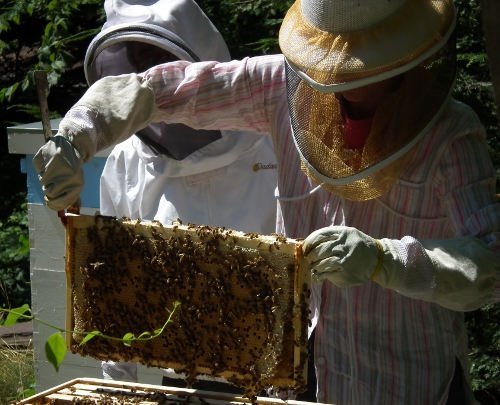
I did my first hive inspection this morning at 9:30 am. There wasn’t much activity outside, but the inside of the hive was abuzz.

When I lifted the outer cover, the inner cover came up with it – it was stuck – immediately exposing the comb that the bees were building to fill up the gap created by the presence of the queen cage.

The “bee space”, which is the space bees prefer to live and work in, is 3/8″. Anything wider and they’ll fill it up with wax comb.

They do this by festooning. See the strings of bees? It’s like they’re holding hands to span the gap.

Beautiful, isn’t it? So light, clean, regular.

Then I checked the queen cage. There were a few bees on it, but they were after the candy, not the queen. The queen wasn’t in it: good news! She must be somewhere in the milling crowd. I put the cage aside, moved the frames  together to achieve the bee space, and added a frame in the opened up space on the side.

The frame feeder was still 3/4 full of syrup, and the pollen patty seemed hardly touched.  Then I closed the box, not wanting to disturb them too much, though truly, even with my clumsy manipulations, they seemed too busy to bother with me. But I didn’t take the frames out to find the queen. Maybe I should have done so, to know exactly where she was, so I wouldn’t inadvertently crush her – ironic, because my main reason for not inspecting further was fear of crushing more of them. It’s unavoidable to crush some of them, no matter how much smoking or brushing one does. So, I’m crossing my fingers that I didn’t crush her.

Black frame with foundation (on which the bees are building comb), extra comb, and empty queen cage.

Empty bee package with some dead bees. The round hole was plugged by the can of syrup  to feed the bees during their trip. The queen cage was suspended inside the box, so the bees were exposed to her pheromones but were not able to harm her until they accepted her (which I hope has happened, the next inspection will tell).

I’ve been watching the hive and there is not too much going that I can see: small scouting parties, hive entrance defense (photo), and the removal of dead bees. All the action is within (or so I hope). Because my hive is new and the frames have only foundation on them, the bees should be busy drawing out comb in which the queen can start laying and they can start storing nectar and pollen. Because they prioritize building, they aren’t flying out yet to forage. It’s for that reason that I provided them a frame feeder with 1 gallon of syrup (medicated) and a pollen patty. A hive loses about 30% of its population after installation of the package, because the new Queen isn’t laying yet.

I am so curious, but the advice is not to open the hive too much at the beginning. The first check we do is a quick one three days after installing, to see if the queen has been released from her cage and, if so, to remove said cage, and to check if there is still enough syrup in the frame feeder. That’s for tomorrow!

~

I noticed yesterday that the Robin was no longer visiting the nest in the bush near our mudroom door. A quick look confirmed our suspicions. The nest was empty. I found 3 of the 4 eggs on the ground. Did a predator get to it and shake them out? The nest looks intact. Did the parents abandon the nest because of all the traffic and push the eggs out (I find that unlikely).

I told Amie the news and she was not saddened, just inquisitive. Who might have done this? A raccoon, a cat? Are the chicks still alive? No. Can we open one? We did and found it was fertile (a small blob of blood). Can we hatch the other ones? No, they were all cracked anyway. Can we keep the egg shell? I’ll have investigate how to preserve an egg like this.

This morning a friend and I drove to the supplier’s place to pick up our packages of 10.000 bees (3 lbs) with a marked Italian Queen. Driving back with a couple of loose bees in the car was no problem: they stuck with their caged compatriots, maybe listening in while we talked doom :)

Installing the package was surprisingly easy. I knew the procedure by heart. I removed the can with the syrup, which opens up the box:

Then I fished out the queen cage:

I shook her helpers off into the hive, checked that she was alive (she was), then looked for the cork that is supposed to cover the candy, and found none (huh?), and so  installed it by wedging it between two frames. Then I shook all the other bees out into the hive.

You shake the box this way and that and they just fall on top of the frame and crawl in. I put the box near the hive entrance, so whatever live bees remained could easily find their way in. Then I carefully pushed the frames together and closed up the hive.

All this with three puffs of smoke and no spraying of the bees with sugar water like it is sometimes advised. The bees seemed happy to be out of that tiny box and into a new, clear home. They started clearing out the dead bees (because unfortunately, with this method, those get shaken in as well) and guarding the entrance right away. I was glad to get out of the bee suit, though: it was an exceptionally hot  and humid day, and the suit was a boiler.

Then came the doubt. Really, no cork? The tiny cork is supposed to cover a piece of candy that the bees chew through to release the Queen: a slow release that helps them get used to her pheromones. If I installed the queen cage with the cork, the queen wouldn’t be able to get out, lay no eggs, and the hive would die. I couldn’t afford to wait till the next inspection, which is in a week.

So I went in again, this time with some trepidation. I found the cork on the candy end of the cage. It was totally covered over with wax. It took me a minute or so to pry it out with my hive tool. Again the bees were docile – luckily, because I had to relight my smoker a couple of times.

I do love the sight of that hive  (just one brood box so far), and the bees flying in and out the entrance (reduced, so they can guard it more easily). I hope they feel at home and find their way around soon.

And Amie? She came running when I got home to see the box and was truly wowed by buzzing and moving of those many bees. Unfortunately I hadn”t come back in time to show it to her preschool class. She wanted to help me install them but I explained we don’t have a suit for her. So she and DH watched through the window.

Excerpt from chat between DH (at office) and myself (at home):

  • me: It’s soooooo windy I fear the hoop house will fly off.
  • DH: It won’t.
  • me: Really?
  • DH: Yeah. Really.
  • me: Check your email.

I had just sent him this:

Yup, that’s our hoop house, SPLAT.

Amie and I were outside for a while in the morning, trying to get the herb spiral going, but the wind got so bad we had to flee inside from the sticks and branches coming down from the trees. We were in the dining room drawing and reading when there was this loud flapping sound followed immediately by a whoosh. I ran to the bedroom window and it was so weird not to see the top of the hoop house where it had been for many months.

But I count ourselves very, very lucky, for many reasons.

  1. No one got hurt.
  2. No plants inside the hoop house got hurt.
  3. I still had little metal hoops over the garlic and rhubarb bed you see in the foreground, so none of these were crushed.
  4. The whole flapping mess got caught by the trees, so it stayed away from the road.
  5. The timing couldn’t have been better: it sheltered the tomato seedlings through last night’s frost, and we were going to dismantle it anyway over the weekend.
  6. And most importantly: THE BEES WERE NOT THERE. If they had not been delayed by a week, their hive would have been right in the path of the flying hoop house and indeed right where it landed. Now that would have been a mess. I can see myself running out there, in veil and gloves…

So there you have it, dear reader. Never say never.

This weekend I did very little gardening. Amie and I did our daily chore of watering the garden that’s in as well as all the seedlings that are  inside the house. That was all. We had planned to recreate the hoop house but instead we saw many friends, attended a hive opening, waited for rain (still none) and relaxed a bit.

The hive opening was the perfect ending to the beekeeping class. It is good to hear the theory and the stories and advice of an experienced beekeeper. But it’s only when you press your nose (actually, your veil) to a frame crawling with honeybees that you know: Yes, I can do this! Three insights were reassuring for me. One, that the bees are so docile. Two, that they did not venture far from the hive (stayed within 10 feet or so) while we were working it, so I won’t have to run down the street to tell the neighbor’s kids to retreat inside the hive for 15 minutes while I work it. Three, that when you accidentally kill a bee while putting in a frame, it is like stepping on someone’s toe, and the reaction is mild.

That last one is what fascinates me the most about bees, that it’s not 10.000, or 40.000 bees, but 1 colony, 1 organism made up of many parts.  My bee package arrives next Monday and I can’t wait.

I am debating what to do with my evening: read poetry or paint more hive parts (I purchased a landing, a screened bottom board and an entrance reducer). Poetry or bees, bees or poetry…

I like my two Earth Machine composters in that they’re contained and so inaccessible to animals, which makes me unafraid to throw in meat, cheese, bones, etc. They’re also, of course, portable, and not too bad to look at. But for those reasons they’re also a pain to turn, and just the two of them won’t give me the quantity of compost I need. I want to add horse manure, grass clippings, more coffee shop coffee grounds and perhaps even some kitchen scraps from neighbors.

So I am in need of something more extensive and easier to turn. Something like the  one at Drumlin Farm. DH helped me make it come true. He made his own design and we put it together, the two of us, over the last couple of days. Here is the almost finished product in situ, off to the side of the veg garden:

It really is huge: 3 boxes 3′ by 3′ by 3′.

It still needs a three-part lid, which we’ll make out of scrap lumber and the old fiberglass roof we ripped off our porch. Time and use will tell if we did well. If it holds up well, I’ll put our plans online.

I’ll still be using my Earth Machines for the kitchen scraps that the wild animals would love to get at, because even with a lid this one is not tight – for one, it has no bottom. So the Earth Machines stay behind the shed, close to the kitchen, and this one will receive their composted and half-composted contents once in a while.

~

I also lit my bee smoker for the first time. I gathered a bucket full of dry pine needles, dry rotten wood and old leaves from our garden, stuffed some of that into the smoker, and lit it on fire. It smoked really well for 20 minutes with only a few puffs. Success!

« Previous PageNext Page »